Event Management vs. Event Production vs. Event Design: What’s the Difference?
By M&T Events Editorial Team | 3 November 2026
Last updated: October 2026
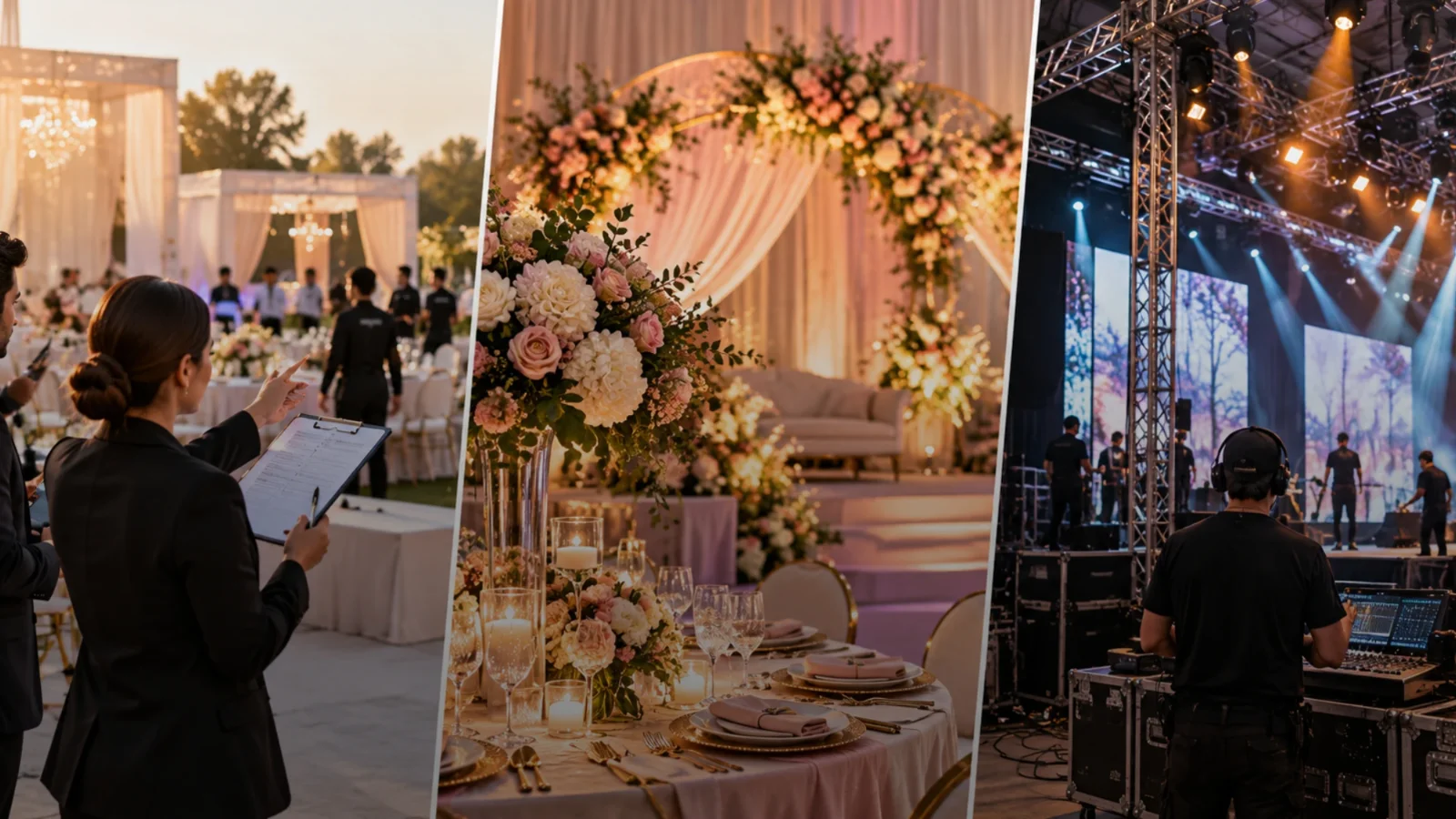
Event management plans and coordinates an event. Event design decides how it looks. Event production builds and runs its physical and technical side. A wedding or a launch usually needs all three, but they are separate jobs with different skills, outputs and deadlines.
The distinction matters most when you compare quotations. One company’s “event management” package may include the stage, lighting and sound, while another’s covers planning and a coordinator on the day and nothing else. A decorator may quote for the backdrop but not the structure it stands on. Once you know which discipline covers which work, you can see what a quote leaves out while there is still time to fix it.
Event Management, Event Design and Event Production Compared
The table compares the three disciplines on the same points: the question each one answers, the work involved, what the client receives and when each is busiest.
| Comparison Criteria | Event management | Event design | Event production |
|---|---|---|---|
| Question it answers | Will the event happen on time and within budget? | What will the event look and feel like? | Will it physically work in this venue? |
| Core work | Budget, timeline, venue booking, vendor contracts, scheduling, on-day coordination | Theme, colour palette, stage and backdrop design, entrance, florals, seating and venue styling | Stage structure, lighting, sound, AV and LED screens, power, setup, testing, live operation, teardown |
| What the client receives | Budget breakdown, vendor list, timeline, run-of-show | Mood boards, floor layouts, 3D visuals, material and floral selections | Technical plan, setup schedule, tested equipment, crew on site |
| When the work peaks | Throughout, from the first brief to the final invoice | Early for concept and approvals, then again at installation | The final days: build, rehearsal and the event itself |
| Who leads it | Event manager or project lead | Event designer | Production manager or technical lead |
| What goes wrong without it | Vendors arrive out of sequence, the budget drifts and nobody is in charge on the day | The venue looks assembled from separate suppliers | The stage, screens or sound fail in front of guests |
| At a baraat | Sets the arrival time and coordinates the hall, caterer and photographer | Designs the stage, entrance and floral palette | Builds and lights the stage and runs the sound |
| At a product launch | Manages approvals, the guest list and vendor briefs | Applies brand guidelines to the stage, screens and signage | Runs the lighting, sound and video cues for the reveal |
The clearest line runs between design and production. Design decides that the stage will carry a floral arch under warm light. Production makes sure the structure can hold the arch and that the lights run on a power supply that will not trip when the caterer’s food warmers switch on.
What Is Event Management?
Event management is the planning and coordination of an event from the first brief to the final teardown. It covers the budget, timeline, venue, vendor contracts, scheduling, the run-of-show and supervision on the day. The event manager is accountable for the whole event, including the parts that designers, production crews and caterers deliver.
An event manager does not choose the flowers or the lighting fixtures. The manager decides when the florist enters the hall, what each vendor is paid, which crew sets up first, and who makes the call when the chief guest is running late. The main working document is the run-of-show, a minute-by-minute schedule that assigns every cue to a named person, from vendor arrival to the last guest leaving.
The term is also used loosely. Some industry glossaries, such as Guidebook’s definition of event production, treat event management as an umbrella term covering both planning and production. In Pakistan, “event management company” is applied to almost any business that works on events, from a decorator to a full-service team. Our guide to what a full-service event management company does explains how to tell them apart.
M&T’s event management service covers planning, coordination, vendor management, scheduling and on-ground execution, either for a whole event or alongside vendors the client has already booked.
What Is Event Design?
Event design is the creative work that decides how an event looks and how guests experience the space: the theme, colour palette, stage and backdrop, entrance, florals, seating layout and the route guests take from the entrance to the stage. Its output is a concept the client approves before anything is built or ordered.
Event design and event decor are closely related but not identical. Design is the concept and the plan. Decor is the styling that carries it out in the venue: florals, fabric, props, table settings and finishing details. Most clients book the two together, which is why M&T offers them as one event design and decor service.
The brief changes with the occasion. A Pakistani wedding often has several functions, and each needs its own look. A mehndi is usually bright and informal, with marigolds and strong colour. A baraat is more formal, and a walima is often calmer and lighter. A designer working across all of them keeps each function distinct while making them feel like one wedding. Corporate design starts from brand guidelines, so logos, colours and typefaces must match across the stage backdrop, LED screens and signage. For a real estate launch, the design has to support the sales presentation, with space for model displays and a stage that works for speeches.
Design work is front-loaded. Mood boards, layouts and 3D visuals come first, then revisions and approval. Custom pieces need workshop time, and florals need ordering, so a late change to the concept affects everything that follows it.
What Does an Event Production Company Do?
An event production company builds and operates the physical and technical parts of an event: the stage structure, lighting, sound, AV and LED screens, power supply, setup and testing, live technical operation and teardown. It turns an approved design and a run-of-show into something that works once guests are in the room.
Production starts with the venue. Before anything is built, the production team checks ceiling height, rigging points, floor load, power capacity, access for trucks and the venue’s setup window. Banquet halls and hotel ballrooms often allow vendors in only at set times, so production schedules are worked backwards from the moment the doors open: structure first, then rigging and lighting, then decor, then the sound check and rehearsal.
The main production elements each carry their own risks.
- Staging covers the platform, steps, ramps and any structure the design adds, built to the approved dimensions and strong enough for what stands on it.
- Lighting covers the stage wash, accent lighting on the decor and lighting for photography and video. Coloured light changes how fabric and flowers look, so the lighting plan is checked against the design.
- Sound covers speaker placement for the size of the room, microphones for speeches or performances and a sound check before guests arrive.
- AV and LED screens need content prepared at the screen’s actual resolution and proportions, or logos stretch and text blurs.
- Power planning sets the load for lighting, sound, screens and catering equipment, with generator backup for load-shedding. Outdoor sites need this most, since a lawn or farmhouse may have no reliable supply near the stage.
Custom fabrication, such as entrance arches, branded walls and stage structures, sits between design and production. The designer specifies the piece, and a fabrication team builds it in a workshop before it is installed on site.
On the day, the production crew operates the equipment and runs the technical cues: the bride’s entrance music, the lighting change for a launch reveal, the walk-in video at a conference. When something fails, the production lead fixes it or switches to the backup. After the event, the same crew dismantles everything within the venue’s handover time.
An event production company is different from an equipment rental supplier. A rental supplier delivers lights, speakers or screens. A production company plans how they are used, operates them and takes responsibility for the result. M&T’s event production services cover stage production, technical and AV setup and on-ground execution.
How the Three Work Together on One Event
Management, design and production run in a sequence with overlaps, and each stage limits what the next can do. A typical event moves through these steps.
- The brief sets the date, venue, guest count and budget. Event management leads this stage.
- The concept turns the brief into mood boards, a layout and 3D visuals. Event design leads this stage.
- A feasibility check tests the concept against the venue: whether the stage fits under the ceiling, whether the power supports the lighting and whether the trucks can reach the loading point. Event production leads to this stage.
- Approval fixes the design, technical plan and budget, and the client signs off on one priced scope.
- Sourcing and fabrication follow: custom pieces are built, florals ordered and equipment booked.
- The build happens at the venue: structure, rigging, lighting, decor installation, sound check and rehearsal.
- On the day, the event manager runs the schedule, the production crew runs the technical cues and the decor team finishes the details before guests arrive.
- Teardown and handover clear the venue, return hired items and settle the final invoice.
Where Handovers Between the Three Go Wrong
Most event-day problems start where one discipline hands work to another.
- A design is approved before production has checked it, and the backdrop turns out taller than the hall’s ceiling allows.
- The stage changes size during planning, and the decorator learns about it on setup day.
- Stage lighting shifts the colours of the florals and fabric, because nobody tested them together.
- The generator trips when the sound system, lighting and food warmers come on at the same time.
- The guest count rises, and the caterer is told, but the seating layout and stage sightlines are not updated.
Each of these is a coordination failure, not a design or technical one. When all three disciplines work from one plan, these checks happen during planning.
Which Service Does Your Event Need?
The service you need depends on what is already arranged. The table matches common situations to the service that fills the gap.
| Your situation | What to book |
|---|---|
| A hotel provides sound and catering, and you want the room styled | Event design and decor |
| You have an in-house events team or a planner but need the stage, lighting and screens | Event production |
| A conference with a fixed agenda, several speakers and presentations | Event management and production, with design built around your brand |
| A wedding with a mehndi, baraat and walima | All three, ideally under one team |
| A product or real estate launch built around a reveal | All three, with production carrying the most risk |
| An outdoor event on a lawn or farmhouse | All three, with production planning power, ground and weather |
Booking the three separately can work for a small event at a venue that supplies most of the infrastructure. For larger events, someone has to own the handovers. If you hire separate companies, confirm in writing who checks the design against the venue, who supplies power and who runs the schedule on the day.
Event Management, Design and Production at M&T Events
M&T Events is a Lahore-based event company that handles event management, design and decor and event production under one team, along with fabrication, catering and brand activations. Wedding decor and event design lead its work, and it also produces corporate events, launches and real estate events. Recent projects include a marigold-themed mehndi, PITB’s Building a Digital Punjab corporate event and a launch event for Rumanza at DHA Multan.
Each service can be booked on its own or as part of full event management. M&T works from Lahore and delivers events in Gujranwala, Sialkot, Islamabad and other cities in Pakistan.
Share your occasion, venue, guest count and date, and M&T will tell you which parts of the event it should handle and what each will involve.
Frequently Asked Questions
Is an event production company the same as an AV rental company?
No. An AV rental company supplies equipment such as speakers, lights and screens. An event production company plans the technical setup for the venue, installs and tests it, operates it during the event and takes responsibility if something fails.
Is event decor the same as event design?
The terms overlap. Event design is the concept: the theme, palette, layout and stage design. Event decor is the styling that carries out that concept in the venue, including florals, fabric, props and table settings. Most companies offer them as one service.
Who is responsible for lighting, the designer or the production team?
Both. The designer decides the look, such as warm light on the stage or coloured washes on the entrance. The production team chooses the fixtures, rigs them, connects the power and runs them during the event.
Does event production include fabrication?
Often, but not always. Fabrication covers custom structures such as stages, arches, backdrops and branded walls. Some production companies build these in-house, while others work with a specialist fabrication team. Ask which applies before you approve the quotation.
Can I hire an event production company without event management?
Yes, if someone else is managing the event, such as an in-house team or a planner. In that case, agree who owns the run-of-show and who coordinates the production crew with the decor and catering teams.